Choosing a Pay Per Call network often starts with two questions: How much volume is available, and at what rate?
Both matter. Neither tells you enough.
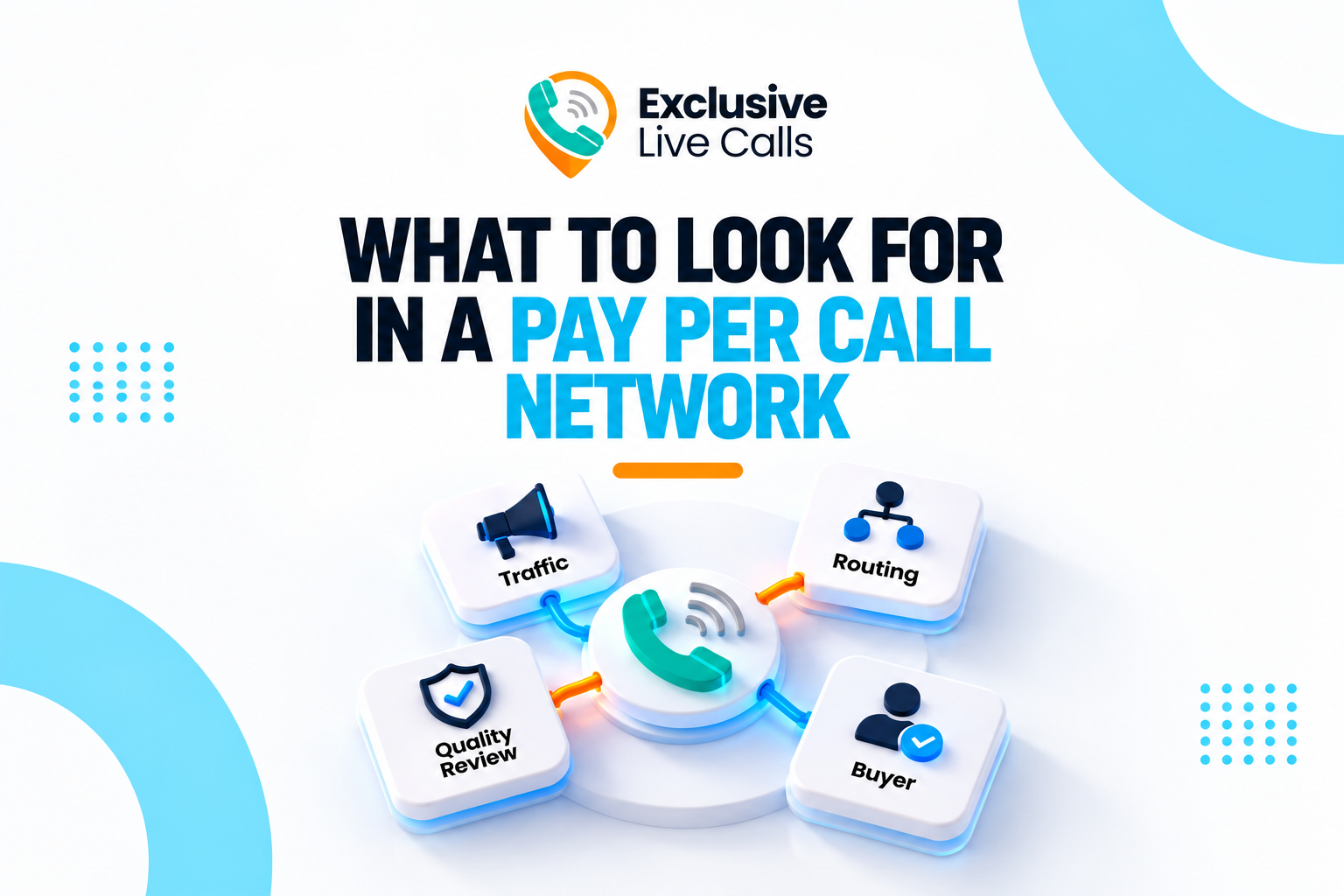
Once a campaign goes live, the network becomes part of the infrastructure connecting traffic sources, publishers, campaign requirements, routing, call data, quality review, and the buyer receiving the call.
That infrastructure matters because a call does not begin when the buyer answers the phone. There is an entire operation behind how that call was generated, qualified, routed, tracked, and reviewed.
For buyers evaluating a Pay Per Call network, understanding that operation can be just as important as understanding the offer itself.
Start With Traffic, Not Volume
Available volume can tell you whether a network has supply. It does not tell you how that supply is generated.
Pay Per Call traffic can come from owned and operated properties, paid media, organic search, listings, external publishers, or a combination of sources.
The path a consumer takes before making the call also matters. Landing pages can help set expectations and connect traffic with the service the consumer is actually looking for.
That is why the conversation should go beyond:
“How many calls can you send?”
A buyer should also understand where those calls are coming from and how the network maintains oversight of the sources producing them.
This does not mean a buyer needs access to every detail of every publisher relationship. It means the network should understand its own supply.
If a traffic source begins producing unusual patterns, campaign mismatches, or quality concerns, there should be enough visibility to identify the issue and investigate it.
Volume becomes much more useful when there is accountability behind it.
For a closer look at what happens before a consumer makes the call, see our breakdown of landing pages in Pay Per Call on Instagram.
Publisher Oversight in a Pay Per Call Network
Publisher vetting is often discussed as an onboarding step. In practice, it should be an ongoing process.
Before approving traffic, a network may review how a publisher intends to generate calls. Creatives, landing pages, live listings, traffic sources, and other supporting materials can provide useful context before a campaign launches.
However, pre-launch review can only tell part of the story.
The real test begins when calls start coming in.
Live traffic can reveal patterns that were not visible during onboarding. A source may begin sending calls outside campaign requirements. Quality can change. Traffic behavior can raise questions that require further review.
For a buyer, the important question is not simply:
“Do you vet your publishers?”
A more useful question is:
“What happens when one of your traffic sources becomes a problem?”
A network should have a process for identifying the source, reviewing the relevant calls, communicating what happened, and taking action when necessary.
That process is part of quality control.
Qualification Needs a Shared Definition
Many campaign problems begin before the first call arrives.
If the buyer, network, and publisher are working from different definitions of a qualified call, disagreements become much more likely once billing and performance enter the conversation.
Campaign requirements should be clear from the beginning.
Depending on the vertical, those requirements may include geography, operating hours, service type, consumer intent, exclusions, call duration, qualification criteria, and other campaign-specific conditions.
The purpose is not to create unnecessary complexity. It is to establish a common reference point.
When the requirements are clear, publishers know what traffic the campaign needs. The network has a framework for managing and reviewing that traffic. Buyers know what they should expect to receive.
The same criteria can then be used when an individual call needs to be reviewed.
A billable call should not become something everyone defines differently after the call has already happened.
Tracking Should Give the Call Context
Tracking is fundamental to Pay Per Call because every call needs attribution.
But attribution alone is not the same as visibility.
Knowing that a call happened and how long it lasted provides only part of the information a buyer may need to understand performance.
Depending on the campaign and platform, call-level data can include timestamps, source information, routing details, duration, recordings where applicable, and qualification data.
That context becomes particularly important when something changes.
A drop in performance cannot be explained by total call volume alone.
When a buyer questions an individual call, duration alone may not resolve the issue.
And when one traffic source begins behaving differently from the others, aggregated reporting may hide the pattern.
Useful reporting should make it easier to move from “something changed” to “here is what changed.”
Routing Should Match the Buyer’s Operation
Generating the right caller is only part of the equation. The call also needs to reach the right buyer under the right conditions.
A campaign may need to account for state or ZIP coverage, business hours, service type, buyer availability, concurrency, capacity, and other routing requirements.
This is where campaign design meets the buyer’s actual operation.
Additional volume has little value if the buyer cannot handle it. A qualified caller from the wrong service area is still a poor match. Traffic that arrives outside the buyer’s operating conditions can also create problems even when the caller has legitimate intent.
Routing is the mechanism that turns campaign requirements into real-time decisions about where a call should go.
In some campaign structures, Real-Time Bidding (RTB) adds another layer to that process by allowing routing decisions to respond dynamically to buyer demand and campaign conditions.
For buyers and publishers who want a closer look at the process, we’ve broken down how RTB works in Pay Per Call on Instagram.
Buyers should therefore look at routing as more than a technical connection. It should reflect how the business actually operates and be able to adjust as those conditions change.
Quality Review Should Go Beyond a Timer
Duration thresholds can be useful in Pay Per Call. They create a measurable condition and can help establish billing rules.
However, a timer cannot explain everything that happened during a conversation.
When a call requires review, the network may need to consider the campaign requirements, consumer intent, call context, routing information, source data, and the conversation itself where recordings are available and applicable.
This matters because quality can otherwise become subjective very quickly.
One side says the call was good. The other says it was not.
A structured review process moves that conversation back to evidence.
What was the caller looking for?
Did the call match the campaign?
Was it routed correctly?
What actually happened during the conversation?
Those questions provide more useful information than duration alone.
Understand How Quality Issues and Disputes Are Handled
Even a well-managed campaign will eventually produce a call that someone questions.
What matters is whether there is a defined way to handle it.
Before choosing a Pay Per Call network, buyers should understand how calls can be submitted for review, what information the QA process considers, how findings are communicated, and how confirmed issues are addressed.
This is also where clear campaign requirements become valuable.
A dispute is much easier to evaluate when both sides can return to criteria that were established before launch rather than negotiating the definition of quality afterward.
The goal should not be to eliminate every disagreement.
It should be to make disagreements reviewable, documented, and actionable.
Compliance Should Be Part of the Operation
Compliance deserves particular attention in verticals where marketing and consumer-contact rules are more demanding.
Buyers should understand how a network approaches publisher oversight, traffic methods, campaign restrictions, and other compliance requirements relevant to the offer.
A policy on paper is only one part of that.
The operational question is whether those standards influence how traffic is approved, monitored, and handled when an issue appears.
Compliance requirements can also vary by vertical, traffic source, geography, and campaign structure. They should therefore be addressed as part of campaign setup rather than treated as a generic assumption.
For buyers, this is another reason traffic transparency and publisher oversight matter.
Price Per Call Does Not Tell You Cost Per Customer
Price matters. But comparing networks only by cost per call can create the wrong incentive.
A cheaper call that rarely produces a qualified opportunity may ultimately cost more than a higher-priced call that consistently reaches the right customer.
The more useful question is what happens after the call arrives.
Does the traffic match the campaign?
Can the buyer handle it?
Does it produce qualified opportunities?
What does acquisition look like once enough data has accumulated?
This shifts the conversation from buying the lowest-priced call to understanding the economics of the campaign.
In performance marketing, the cheapest input is not automatically the most efficient outcome.
Why Pay Per Call Network Support Matters After Launch
A campaign can be configured correctly on day one and still need adjustments later.
Buyer capacity changes. Coverage expands or contracts. Traffic sources perform differently. Hours change. Volume fluctuates. Individual calls need review.
That is why support should not be evaluated only by how responsive a network is during onboarding.
Buyers should understand what communication looks like after launch.
Who handles campaign changes?
How are quality concerns escalated?
How quickly can routing or coverage be updated?
What happens when performance begins moving in the wrong direction?
A dashboard can show what is happening. The team behind the campaign determines what happens next.
Questions to Ask a Pay Per Call Network Before Launch
A buyer does not need to turn every network conversation into an audit.
But a few questions can reveal a great deal about how the relationship will work.
Where does your call traffic come from?
How do you review publishers before and after they go live?
How will our qualification criteria be defined?
What call-level information will we be able to see?
How does routing account for our coverage and capacity?
What happens when we question the quality of a call?
How are traffic or compliance concerns investigated?
Who manages the campaign once we go live?
A network that can answer those questions clearly gives a buyer something more valuable than a volume estimate: a view into how the operation actually works.
What to Look for in a Pay Per Call Network
There is no single metric that identifies the right Pay Per Call network.
Volume matters. Pricing matters. Coverage matters. Technology matters.
But those factors become more meaningful when buyers understand the infrastructure connecting them.
Traffic sourcing determines where calls begin. Publisher oversight helps protect the campaign as traffic develops. Qualification criteria establish what the buyer is trying to receive. Tracking and reporting provide visibility. Routing connects each call to the appropriate destination. Quality review provides a process when performance needs a closer look.
Communication keeps those pieces aligned as conditions change.
That is the larger picture buyers should evaluate.
The question is not simply whether a network can send calls.
It is whether you understand and trust the operation behind them.
Working With Exclusive Live Calls
At Exclusive Live Calls, we work with buyers to understand their campaign requirements before traffic begins and continue reviewing performance as campaigns develop.
Our approach includes inbound call traffic, campaign-specific routing, call-level reporting, publisher oversight, and QA review to help maintain alignment between supply and buyer requirements.
If your team is evaluating Pay Per Call or looking to expand an existing campaign, learn more about becoming an ELC Pay Per Call buyer and connect with our team to discuss your vertical, coverage, capacity, and campaign requirements.