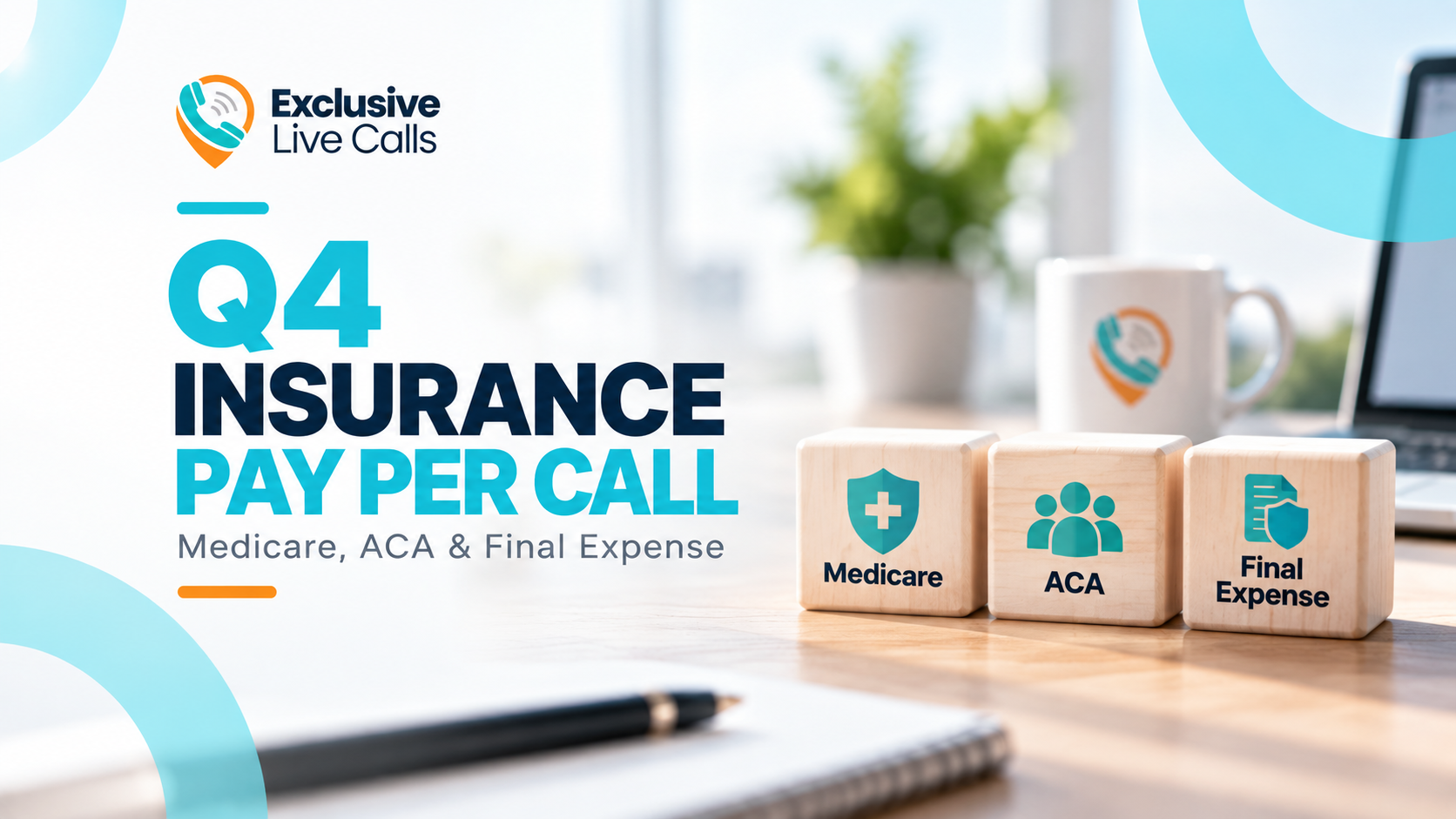
Q4 Insurance Pay Per Call brings several seasonal demand cycles together.
Enrollment periods, renewals, consumer needs, and other market changes can increase activity at different points throughout the year. Q4 brings several of those changes together, particularly across health insurance.
For Pay Per Call, however, higher seasonal demand is only part of the picture.
Medicare enters its Annual Enrollment Period. The ACA Marketplace moves into Open Enrollment. Meanwhile, Final Expense continues under a different demand cycle that does not depend on the same enrollment windows.
That means Q4 Insurance Pay Per Call is not one market moving in one direction.
For buyers and publishers, each vertical can bring different consumer intent, qualification requirements, GEOs, compliance considerations, capacity needs, and routing decisions.
Understanding those differences matters before increasing traffic simply because Q4 has arrived.
For a broader look at seasonal demand across Insurance, Home Services, Financial Services, and other categories, read our Q4 Pay Per Call Guide: Where Demand Shifts and How to Prepare.
Insurance Is Not One Pay Per Call Market
It is easy to group Insurance into a single vertical.
In practice, Medicare, ACA, and Final Expense operate under different conditions.
A Medicare campaign may focus on eligible consumers during a defined enrollment period.
An ACA campaign may depend heavily on GEO, eligibility, enrollment status, and specific buyer requirements.
Final Expense reaches a different consumer and does not rely on the same annual enrollment window.
For publishers, this means asking more than:
“Do you have Insurance campaigns?”
More useful questions include:
Which vertical? Which GEOs? What qualifies? Which traffic sources can I use? When can the buyer receive calls? What makes a call billable?
Those details determine whether the traffic actually fits the campaign.
Medicare Pay Per Call During Q4
Medicare provides one of the clearest examples of seasonality within Insurance.
The Annual Enrollment Period (AEP) runs from October 15 through December 7. During this period, eligible Medicare beneficiaries can review their coverage and make certain changes for the following year.
For Pay Per Call, AEP affects more than consumer activity.
During a concentrated enrollment period, consumer interest, advertising activity, agent availability, buyer capacity, and competition for qualified traffic can all change.
That makes current campaign information especially important.
Before sending or scaling Medicare traffic, publishers should confirm:
- Accepted GEOs
- Consumer qualification criteria
- Approved traffic sources
- Campaign hours
- Billable-call requirements
- Daily or weekly caps
- Current buyer capacity
- Compliance requirements
An active Medicare campaign does not necessarily mean a buyer can accept every Medicare call.
The consumer still needs to meet the campaign requirements.
ACA Pay Per Call During Open Enrollment
The ACA Marketplace enters another important enrollment period during Q4.
Open Enrollment gives consumers a defined period to review Marketplace coverage and enroll in a plan for the upcoming year.
From a Pay Per Call perspective, this can increase consumer activity. However, activity and qualification are not the same thing.
An ACA caller may still need to meet campaign-specific requirements related to location, eligibility, current coverage situation, age, or other buyer criteria.
Requirements can also vary between campaigns.
As a result, a caller who fits one buyer may not fit another.
Accurate targeting becomes important before the call reaches the buyer.
Publishers need to understand who the campaign accepts, while buyers need to keep their requirements, available GEOs, schedules, and capacity current.
When either side works with outdated information, additional volume can quickly become inefficient traffic.
Final Expense Follows a Different Demand Cycle
Final Expense belongs to Insurance, but it should not automatically follow the same strategy as Medicare or ACA.
The main difference is straightforward:
Final Expense does not depend on the same annual enrollment windows.
Consumers can research Final Expense coverage throughout the year. Therefore, it creates a different acquisition environment from an enrollment-driven Medicare or ACA campaign.
Seasonality can still influence consumer behavior, advertising conditions, buyer demand, and campaign capacity.
However, publishers should evaluate Final Expense on its own terms.
The consumer profile, intent, qualification criteria, traffic source, and buyer requirements may differ significantly from other Insurance campaigns.
A strategy that works during Medicare AEP should not automatically become the strategy for Final Expense.
Three Insurance Verticals. Three Different Calls.
Medicare, ACA, and Final Expense can all generate inbound Insurance calls.
But the context behind those calls can be very different.
Before determining where a call should go, several variables may matter:
Insurance Vertical → GEO → Consumer Qualification → Traffic Source → Campaign Hours → Buyer Capacity → Routing
Each variable can affect buyer fit.
For example, a Medicare call may meet one buyer’s criteria but not another’s.
An ACA caller may live in a state one campaign accepts while another does not.
Similarly, a Final Expense caller may match the general target audience but still fail another campaign-specific requirement.
This is why call volume alone does not tell the full story.
The better question is whether the traffic matches the demand available on the buyer side.
More Insurance Demand Does Not Make Every Call More Valuable
Enrollment periods can increase consumer activity.
That does not automatically make every incoming call more valuable.
If publishers increase volume without maintaining accurate qualification, buyers may receive more consumers they cannot serve.
Traffic that expands beyond accepted GEOs may also have nowhere appropriate to go.
In addition, qualified consumers can still arrive when agents cannot handle them if buyers reach capacity while traffic continues to increase.
This is why volume, quality, and capacity need to move together.
Higher demand should not lower traffic standards.
In fact, higher volume makes source transparency, qualification, compliance, QA, and communication even more important.
A small targeting problem at low volume can become a much larger issue once traffic scales.
What Insurance Publishers Should Know Before Scaling
Q4 can create opportunities to increase Insurance traffic.
Publishers should still understand exactly what they are scaling.
Before increasing volume, confirm:
- Insurance vertical
- Accepted GEOs
- Consumer qualification criteria
- Approved traffic sources
- Operating hours
- Available caps
- Billable-call criteria
- Payout structure
- Current buyer capacity
- Compliance requirements
These conditions can change throughout the season.
A buyer may adjust GEO coverage, while caps and capacity can increase or decrease. Campaign hours and qualification requirements can also shift as performance develops.
For that reason, current campaign information matters more than assumptions.
Instead of treating increased Q4 demand as a reason to immediately scale, publishers can start with controlled volume, review performance, and increase traffic based on actual campaign results.
Insurance Buyers Need to Prepare for the Volume Too
Seasonal demand affects more than traffic generation.
It also affects the operation receiving the calls.
During periods of increased Insurance activity, buyers may need to handle more conversations within a shorter period of time. As a result, agent availability, campaign hours, call capacity, and routing become part of the acquisition strategy.
Before increasing volume, buyers should have a clear understanding of:
- Target consumer
- Serviceable GEOs
- Qualification requirements
- Agent availability
- Operating hours
- Daily and weekly capacity
- Campaign caps
- Accepted traffic sources
- Billable-call requirements
A campaign can have strong traffic and still struggle if the receiving operation cannot handle the volume.
For example, increasing a campaign from 50 calls to 100 calls only creates additional opportunity if the buyer has enough capacity to answer, qualify, and work those additional calls.
For this reason, publishers and networks need current capacity information before scaling traffic.
Routing should also reflect operational changes as quickly as possible when agent availability changes, a GEO closes, or a daily cap is reached.
Scaling traffic and scaling the operation receiving it need to happen together.
Routing Insurance Calls During Q4
More volume also puts additional pressure on routing.
The right consumer still needs to reach the right buyer at the right time.
A routing decision may consider:
GEO → Vertical → Qualification → Schedule → Capacity → Buyer Fit
In a static setup, calls can follow predetermined routing rules.
With Real-Time Bidding (RTB), information about an incoming call can go to eligible buyers before the call connects. Buyers can then evaluate the opportunity based on their campaign criteria and decide whether to bid.
This creates a more dynamic routing environment when buyers have different GEOs, requirements, capacity, and demand.
However, RTB does not remove the need for accurate campaign information.
The highest bid alone does not determine whether a call is the right fit.
The buyer still needs to meet the routing criteria and have the capacity to handle the call.
As Q4 Insurance Pay Per Call activity changes, keeping that information current becomes increasingly important.
Why Quality Matters More as Volume Increases
More volume also creates more data.
As a result, patterns can become easier to identify than when reviewing one call in isolation.
Instead of evaluating Insurance traffic only by total call count, buyers, publishers, and networks can consider factors such as:
Consumer intent. Qualification. Traffic source. Call outcomes. Repeat behavior. Recurring issues.
One unusual call does not necessarily define an entire traffic source.
A repeated pattern provides much more context.
This is where Quality Assurance becomes particularly important at scale.
Publishers need useful feedback they can act on, while buyers need visibility into the traffic they receive.
At the same time, networks need enough information from both sides to determine whether an issue comes from traffic quality, targeting, qualification, routing, buyer capacity, or campaign fit.
Without that context, it becomes easy to solve the wrong problem.
Building a Better Q4 Insurance Pay Per Call Strategy
There is no single Q4 Insurance strategy because there is no single Insurance market.
Medicare operates around a defined annual enrollment period.
ACA enters its own Open Enrollment environment with specific targeting and qualification considerations.
Final Expense follows a different demand cycle.
What connects all three is the need to match the right consumer with the right buyer under the right campaign conditions.
Publishers need to understand the campaign before increasing traffic.
Buyers need to keep GEOs, capacity, qualification criteria, schedules, and campaign requirements current.
Networks can then use information from both sides to make better routing and campaign decisions.
Insurance is also only one part of the seasonal Pay Per Call landscape.
For a broader look at how Q4 affects Insurance, Home Services, Financial Services, buyer capacity, traffic quality, and routing, explore our Q4 Pay Per Call Guide: Where Demand Shifts and How to Prepare.
Q4 can increase Insurance activity. It does not make every Insurance call more valuable.
The value comes from generating the right consumer, qualifying the traffic correctly, and connecting that consumer with a buyer prepared to handle the call.
Insurance Pay Per Call With Exclusive Live Calls
At Exclusive Live Calls, we work directly with publishers and buyers to understand the conditions behind each Insurance campaign before traffic begins.
For publishers, that means discussing traffic source, Insurance vertical, GEO, expected volume, campaign requirements, and payout expectations.
For buyers, it means understanding the calls you need, where you can accept them, your qualification criteria, and the capacity available to handle them.
As Q4 develops, keeping those details aligned becomes even more important.
If you are looking to generate or receive Insurance calls, you can connect with our team to discuss current opportunities and campaign requirements.
You can also explore how to become an ELC publisher or become an ELC buyer.
Schedule a Meeting With Exclusive Live Calls →
Better Insurance campaigns start with understanding exactly what is behind the call.